What Makes a Container Good for Its Contents?
Choose a container for its contents by matching the opening, shape and handling to the task, so items are easier to retrieve and put away.
The common mistake with choosing a container for its contents is judging it by how neatly it fits a shelf, then finding that the item catches, tangles or needs awkward unpacking. That costs time each time you use it and can make a useful object feel like a nuisance. Start with what your hands do to the contents, not with a matching set.
Think about whether the item is lifted, poured, folded, carried or kept intact. Those motions determine which opening, support and closure will help; appearance and shelf footprint come afterwards.
Match the opening to the way you retrieve items
A container’s opening controls how much effort retrieval takes. A broad, shallow tray works for pieces picked out individually, while a jar with a narrow neck suits contents that can be poured or tipped. If you have to reach past a rim or pull out several layers to reach one object, the shape is working against the task.
Consider what your hand needs to do. Small components may call for a spoon or scoop; a handled tool needs room for fingers to grasp it without pinching against the sides. A lid can keep dust off, but it is only helpful if opening and closing it fits the item’s routine.
Give each item room to keep its useful shape
Some objects are damaged or made awkward by bending, stacking or compression. Store papers flat or upright with support, and let cables curve loosely rather than forcing them into a tight coil. For a fragile ornament, separate contact points with a divider or soft material so neighbouring items do not rub together during ordinary handling.
Check the container’s interior as well as its outer dimensions. A box may fit a shelf but have corners that catch fabric, a base that tips a tall object, or a depth that makes a flat item hard to lift. A folded cloth, card divider or shallow insert can address a specific snag without replacing the whole container.
Choose protection for the actual exposure
A cover is useful when contents need shielding from dust, spills, light or incidental contact. It may be unnecessary for a robust object that is handled often, and a close-fitting lid can make retrieval needlessly fiddly. For food or items requiring particular care, follow the product label or manufacturer’s instructions rather than assuming any household jar is suitable.
Protection can also come from how items are arranged. A padded sleeve may prevent a tool from scratching another object; a rigid divider can stop small ceramics knocking together. Avoid adding layers that hide the contents or make routine access harder than the risk warrants.
Which container suits the task?
What works for objects you lift one at a time?
Use a shallow dish or a wide-opening box when fingers need to select one piece without moving the rest. If pieces can spill when the container is disturbed, choose higher sides and keep it on a stable surface.
What works for parts that belong together?
A compartmented box or a tray with a removable cup can keep related parts in one place while separating pieces that should not tangle or touch. If the compartments make the set difficult to return, use a simpler open container and group only the parts that need separation.
Should a container have a lid?
Choose a lid when the contents need shielding or the container will be moved where items could fall out. If access is frequent and protection is not needed, an open form may be easier; if dust is a concern, a removable lid is less cumbersome than a tight seal.
How can I tell if the container is too deep?
If reaching one item requires lifting or shifting several others, the depth is creating an inconvenient layer. Move those frequently used contents to a shallow container, or reserve the deeper one for objects retrieved together.
Work through the fit before settling on a container
Use this check in the intended storage place. Each observation points to a different choice; a container can pass some checks and fail others.
- Opening: Try the hand movement needed to remove the item. If fingers or a tool cannot reach it cleanly, choose a wider opening or a shallower form; if access is easy, keep the current opening.
- Shape: Place the item in its natural position. If it bends, catches or has to be forced, choose a longer, flatter or more supportive container; if it rests naturally, retain the fit.
- Retrieval: Remove the item you use most. If other contents must be shifted, move frequent-use items to a separate shallow container; if they lift out directly, keep them together.
- Containment: Gently move the container as it would be handled. If pieces slide, spill or knock together, add a divider or choose higher sides; if they stay safely in place, avoid extra padding.
- Protection: Check whether dust, light, spills or contact can reach the contents in their actual location. If exposure could harm them, use a suitable cover or inner sleeve; if not, leave the container open for easier access.
- Return: Put each item back after use. If doing so requires precise rearranging, choose a roomier or simpler container; if items return without fuss, the arrangement is workable.
- Placement: Set the container in its intended cupboard or on its shelf. If it blocks another item or catches on the opening, choose a different shape or position; if it can be removed and replaced smoothly, keep that spot.
Compare containers with a worked example
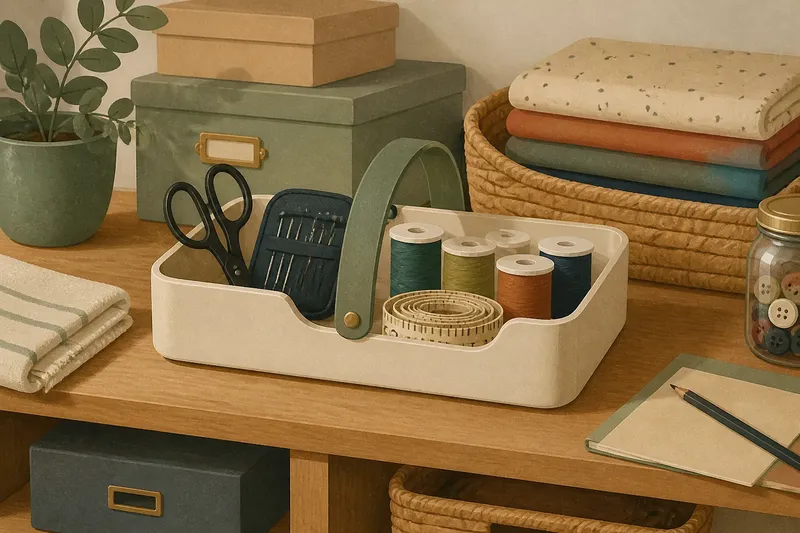
Imagine you have a hypothetical sewing kit consisting of scissors, a needle case, several thread spools and a tape measure, all currently placed in a deep tin. You want to retrieve one tool without tipping out the rest, and the tin’s lid takes extra handling. First, you remove the contents and group the needle case and scissors apart from the spools, so their edges do not catch on thread. Next, you place the group in a hypothetical shallow, open caddy and set it on the shelf where the tin sat. You lift out the tape measure and return it; if it clears the rim and the spools remain in place, the caddy suits the routine. The trade-off is less dust protection, so if the shelf is exposed, a lidded box with a broad opening is the more suitable choice.
That comparison does not require buying a new organiser. A clean food jar, spare dish, sturdy gift box or small basket may already provide the right opening or support, provided its material and condition suit the contents.
For a container chosen for its contents, the decisive question is whether the object can be taken out, used and returned in its ordinary way. Check the fit in the cupboard or on the shelf itself, then adjust only the feature that causes difficulty: opening, support, separation or protection.